Baal girne ka ilaj: ghar par kya karein, aur doctor kab zaroori hai
An honest look at baal girne ka ilaj for men: which home remedies (onion juice, oils, rosemary, eggs) have any evidence, what you can do at home, which tests to get, and when to see a dermatologist.
Key points
- Home care can support healthy hair, but no home remedy has been shown to reverse male-pattern baldness.
- Onion juice and rosemary oil have only small, early studies. They're unlikely to harm most people, but don't expect miracles, and stop if your scalp gets irritated.
- Check for fixable causes: iron deficiency, thyroid problems, low protein intake, crash diets, recent illness (dengue, typhoid), and dandruff.
- If your hairline or crown keeps thinning, see a dermatologist early. Proven treatments work best when started sooner.
Every family has a hair fall expert. One uncle swears by mustard oil, a khala recommends onion juice, a friend has a "100% guaranteed" herbal oil from a Facebook page, and the barber has his own powder. So what actually works?
This guide gives you an honest, evidence-based answer: what you can do at home, what's mostly a myth, and when it's time to see a doctor. For a detailed explanation of causes and medical treatments, read hair fall in men: causes and treatments that work.
First, know which type of hair fall you have
The right "ilaj" depends on the cause:
- Receding hairline or thinning crown, slowly over years: usually male-pattern baldness. Home remedies won't reverse it, but medical treatments can slow it.
- Sudden shedding all over the head, a few months after illness, surgery, stress or crash dieting: usually telogen effluvium, which tends to recover by itself within months.
- Round bald patches: possibly alopecia areata. See a dermatologist.
- Itchy, scaly, red scalp: possibly dandruff, fungal infection or psoriasis, which needs proper treatment.
Home remedies: what does the evidence say?
Onion juice (pyaz ka ras)
A small study published in 2002 tested onion juice in people with alopecia areata (patchy hair loss, not male-pattern baldness) and reported some regrowth. The study was small and had limitations, and there's no good evidence that onion juice helps male-pattern baldness. It can also irritate the scalp and smells strongly.
Verdict: unlikely to help male-pattern baldness. If you want to try it, patch-test first and stop if it irritates.
Rosemary oil
A small 2015 trial compared rosemary oil with 2% minoxidil in men with male-pattern baldness and found similar modest results after 6 months, but the study was small, and 2% minoxidil is a lower strength than usually used for men.
Verdict: an interesting early finding, not proof. If you try it, dilute it properly, and don't use it as a reason to delay seeing a doctor if hair loss is progressing.
Coconut, mustard, castor and "herbal" oils
Oiling can make hair softer, shinier and less likely to break, and a head massage can feel relaxing. Some lab studies suggest coconut oil reduces protein loss from hair. But oils don't regrow hair lost to male-pattern baldness.
Verdict: fine for hair condition, not a treatment for baldness. Don't leave heavy oil on for days if you have dandruff, as it can worsen it.
Eggs, yoghurt and hair masks
These may improve how hair feels, but there's no evidence they treat hair loss.
Aloe vera, amla, methi
Widely used, with very limited evidence for hair regrowth. Probably harmless for most people when used on the scalp, but patch-test first.
"Guaranteed" herbal oils and powders
Be very careful. Unregulated products may contain undeclared ingredients, and some sellers make false claims.
What you can do at home that does help
1. Eat enough protein and a balanced diet
Hair is made of protein (keratin). Very low protein diets, crash diets and rapid weight loss can trigger hair shedding. Include eggs, daal, chana, dahi, milk, chicken, fish or meat daily.
2. Check your iron, thyroid and vitamin levels
Ask a doctor about blood tests if you have other symptoms or sudden shedding:
- Complete blood count and ferritin (iron stores)
- TSH (thyroid)
- Vitamin D and B12, if indicated
Correcting a real deficiency can help hair recover. But taking iron or vitamin supplements without a deficiency won't help and can be harmful.
3. Treat dandruff
If your scalp is itchy and flaky, use an anti-dandruff shampoo (for example, one containing ketoconazole, zinc pyrithione or selenium sulfide) two or three times a week, leaving it on for a few minutes before rinsing.
4. Be gentle with your hair
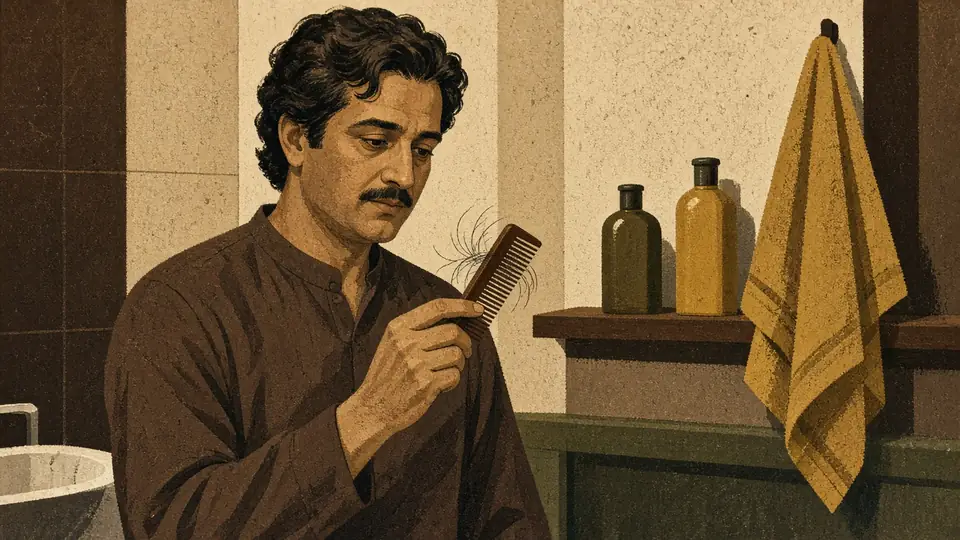
- Don't comb wet hair roughly; use a wide-tooth comb.
- Avoid very tight styles, harsh chemical treatments and excessive heat.
- Wash with a mild shampoo as often as you need. Regular washing doesn't cause baldness.
5. Quit smoking
Smoking has been linked to hair loss and early greying in some studies.
6. Manage stress and sleep
Severe stress can trigger shedding. Exercise, sleep and support from people around you help.
7. Avoid steroids
Anabolic steroids and testosterone used for gym gains can speed up male-pattern baldness.
When to see a doctor (and what they can offer)
See a doctor or, ideally, a dermatologist (skin specialist) if:
- Your hairline or crown is steadily thinning
- You notice patches, redness, scaling, pain or scarring
- Shedding is sudden and heavy
- Home care hasn't helped after 3–6 months
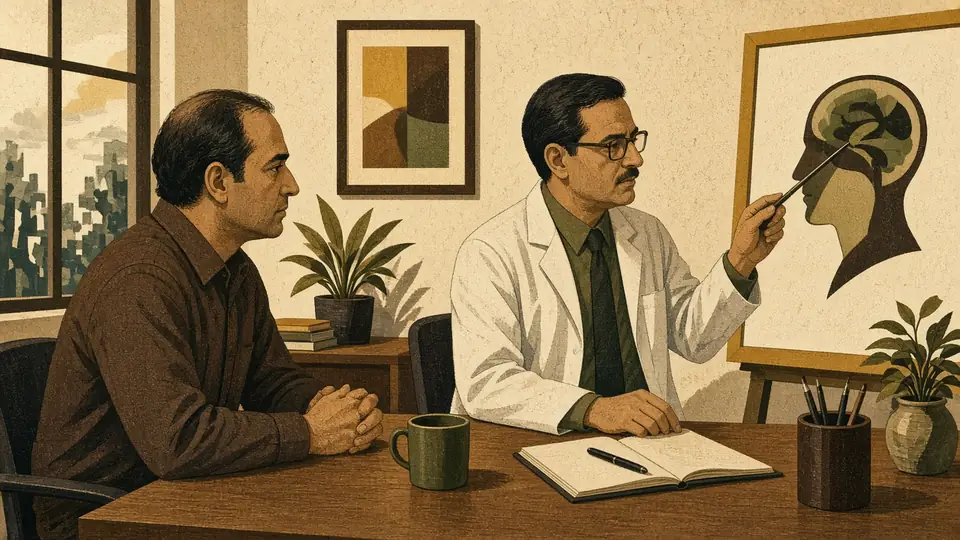
A dermatologist can examine your scalp, sometimes with a magnifier (trichoscopy), order tests, and discuss evidence-based treatments such as minoxidil, prescription finasteride and, for suitable men, hair transplant. Read hair fall in men and hair transplant in Pakistan: what to check.
Be cautious with clinics
Some clinics sell expensive "packages" of treatments with limited evidence. Ask:
- Is the person treating me a qualified, registered doctor?
- What's the evidence for this treatment?
- What results can I realistically expect, and by when?
- What are the total costs and side effects?
Realistic expectations
- Medical treatments take 3–6 months to show any effect, and up to a year for full results.
- They need to be continued to keep working.
- They're better at keeping existing hair than regrowing hair in completely bald areas.
Ek simple 90-din plan (a simple 90-day plan)
Hair care is slow. Hair grows roughly 1 cm a month, and most treatments take 3–6 months before you can judge them. A simple plan:
- Day 1: Take clear photos of your hairline and crown in the same light. Note any recent illness, stress, crash diet or new medicine.
- Weeks 1–2: If hair fall is sudden or heavy, or you have other symptoms, see a doctor. Ask whether blood tests (such as blood count, ferritin, thyroid, vitamin D or B12) are appropriate for you rather than guessing with supplements.
- Weeks 1–12: Wash your hair regularly with a mild shampoo, use an anti-dandruff shampoo if you have flakes, avoid tight styles and harsh heat, eat enough protein, and sleep properly.
- Month 3: Compare photos. If the pattern looks like male pattern baldness and it bothers you, discuss evidence-based treatment with a dermatologist instead of trying another oil.
Paise kahan zaya hotay hain (where money gets wasted)
- "Hair regrowth" oils, serums and shampoos with dramatic before-and-after photos
- Expensive multivitamins when you aren't deficient
- Switching products every few weeks, so nothing gets a fair trial
Be patient, be consistent, and get a proper diagnosis.
See a doctor promptly if
- You notice bald patches, a red, scaly or painful scalp, or pus or scarring.
- Hair loss is sudden and heavy, or comes with tiredness, weight loss or other symptoms.
- You've tried home care for 3–6 months and your hair is still thinning.
Frequently asked questions
What is the best home remedy for hair fall?
No home remedy has been proven to reverse male-pattern baldness. Eating enough protein, treating dandruff, being gentle with your hair and checking for deficiencies are the most useful things you can do at home.
Does onion juice really regrow hair?
Only one small, older study suggested it might help patchy hair loss (alopecia areata). There's no good evidence it helps male-pattern baldness.
Can oiling stop hair fall?
Oiling can improve hair condition and reduce breakage, but it doesn't stop hair loss caused by male-pattern baldness.
Which blood tests should I get for hair fall?
A doctor may suggest a blood count, ferritin (iron), thyroid (TSH) and sometimes vitamin D and B12, depending on your symptoms.
When should I see a dermatologist for hair loss?
If your hair is steadily thinning, you have bald patches or scalp symptoms, or home care hasn't helped within 3–6 months.
Sources
- American Academy of Dermatology. Hair loss: diagnosis and treatment.
- American Academy of Dermatology. Tips for healthy hair.
- Sharquie KE, Al-Obaidi HK. Onion juice (Allium cepa L.), a new topical treatment for alopecia areata. Journal of Dermatology, 2002.
- Panahi Y, et al. Rosemary oil vs minoxidil 2% for the treatment of androgenetic alopecia: a randomized comparative trial. Skinmed, 2015.
- NHS. Hair loss.
- NHS. Dandruff.
Sources were checked on 26 November 2026. Found an error? Tell us and we will correct it.
Medical disclaimer: This article is general information, not a diagnosis or treatment plan. Please talk to a qualified doctor about your own situation. Read our full disclaimer.
Weekly tips for men over 35
Baal, skin aur beard: what actually works, in one short email a week. Free, no spam.
We only use your email to send this newsletter and never share it. Unsubscribe anytime, every email has a one-click link. Privacy policy
Shukriya! You're on the list. Pehli email jald aayegi.
Something went wrong. Please check your email address and try again.